Wholesale auto parts is a category that looks straightforward from the outside and gets complicated fast once you go behind the counter. A mechanic needs the exact part - the right OEM cross-reference, the right manufacturer, the right vendor pricing tier - and they need to know whether it is in the warehouse at Riga, in transit from Lithuania, or on request from a supplier in Germany. The wrong answer wastes hours. The slow answer costs the next job.
Auto Kada is one of Latvia's leading wholesale auto parts suppliers, serving workshops, mechanics, and partner businesses across the Baltics and beyond. Their catalog runs to more than 735,000 SKUs across every category - brakes, suspension, body parts, electrical, fluids, cabin interiors, air systems - sourced from a network of vendors and held across multiple warehouse locations. When their professional customers need a part, the system underneath has to answer fast, accurately, and at scale.
That is the platform Codnity Dev built.
The Brief - A Custom Platform for Professional Buyers
Auto Kada's buyers are not consumers shopping for a single item. They are professional mechanics and workshop owners running shifts under time pressure, often ordering dozens of parts a day, working from established vendor relationships and contract pricing. Off-the-shelf B2C e-commerce platforms are not built for this. Most generic B2B platforms get part of the way and then break down on the specifics: multi-warehouse stock semantics, per-customer pricing, OEM/cross-reference search across 735,000 SKUs, country and language switching, and the operator workflows that wholesale businesses rely on.
The brief was deliberate. Build the platform that the business actually needed, from the ground up, around how the people using it actually work.
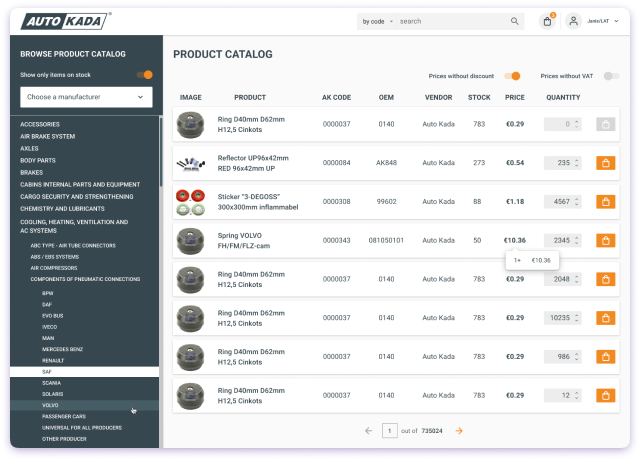
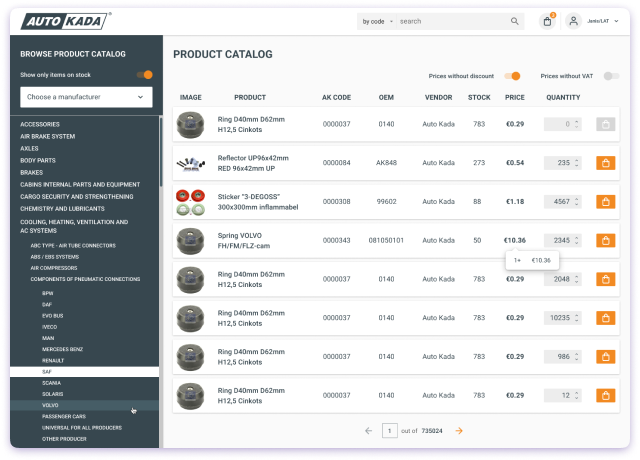
The desktop catalog - product list with AK code, OEM cross-reference, vendor, multi-warehouse stock, and price tiers. Discount and VAT toggles surface the right view for the customer in front of you.
The Catalog at Scale
735,000 SKUs is the number that shapes every design decision. At that scale, search has to be fast and forgiving. Customers know parts by AK code, by OEM number, by manufacturer reference, sometimes by a description that approximates the part rather than naming it. The platform supports all of those entry points and returns results that are ranked by relevance and filtered by what is actually available to that customer.
The sidebar taxonomy mirrors how mechanics think: by system (air brake, axles, cooling, body parts, cargo security), then by manufacturer (BPW, DAF, Iveco, MAN, Mercedes-Benz, Renault, SAF, Scania, Solaris, Volvo) where the customer is shopping for a specific vehicle. Drill down into a category, and the list responds without a page reload.
Real-Time Inventory Across Multiple Warehouses
The single most important question a wholesale buyer asks is: where is it, and how soon can I get it? The platform answers that at every level - on the listing, on the product page, and in search results - using colour-coded availability indicators that distinguish between stock at the central warehouse, stock in Riga, stock at other regional locations, items in transit, and items on request from upstream suppliers.
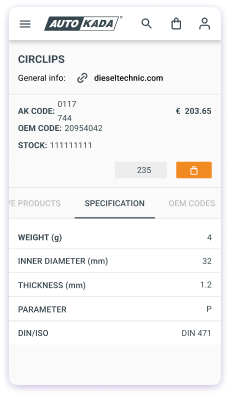
Mobile catalog with real-time, colour-coded availability - Centre, Riga/Latvia, Lithuania, in transit, on request. The buyer sees the answer before they tap into the product.
This is more than a status icon. It is a contract between the platform and the buyer: the number you see is the number you can rely on. Stock figures are pulled in real time from the underlying ERP and warehouse systems, not refreshed nightly. A part sold to one customer this morning shows as unavailable to the next customer this afternoon, no manual intervention required.
Per-Customer Pricing, Built for Wholesale Reality
Wholesale pricing is not a single number. It is a function of the customer (their tier, their contract, their volume), the product (margin category, vendor terms), and the moment (active promotions, end-of-quarter incentives). Off-the-shelf platforms approximate this with simple discount codes. The Auto Kada platform encodes the actual logic.
Every logged-in customer sees prices computed for them: list price, their contract discount, applicable promotions, and the choice of viewing with or without VAT, with or without discount applied. The toggles at the top of the catalog let the buyer flex between views depending on what they are calculating - margins, costs to client, or the actual line they will pay.
Built for the Shop Floor - Mobile First
A significant share of Auto Kada's buyers are on phones - on a workshop floor, in a van, at a customer site. Mobile is not a secondary view. The product detail page is designed for that context: large, clear specifications, tabbed access to related products and OEM codes, prominent price and stock, and a one-tap quantity-and-cart action.
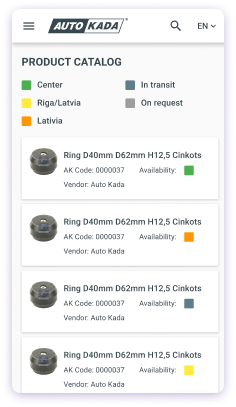
The mobile product view - specifications surfaced in a clean table, OEM cross-reference and stock immediately visible, quantity and cart accessible without scrolling.
Every spec the buyer needs to verify the part is the right one - weight, inner diameter, thickness, parameter, DIN/ISO standard - is one tap away. No marketing copy in the way, no upsell modules. Just the information the buyer needs to be confident they are ordering the correct part.
Customer Impersonation and Multi-Country Operator Tools
One of the less-visible parts of the build is the layer underneath the customer-facing platform: the operator tools Auto Kada's team uses to support, advise, and serve professional buyers. Sales operators can impersonate a customer's account to see exactly the prices, stock, and discounts that customer sees. Support becomes precise rather than approximate. Order assistance happens against the same data the buyer is looking at.
The platform also serves customers across five markets - Latvia, Estonia, Lithuania, Russia, and Sweden - with country and language switching built into the core navigation, not bolted on. Different markets have different vendor catalogs, different pricing conventions, and different language preferences. The architecture handles all of it from one codebase.
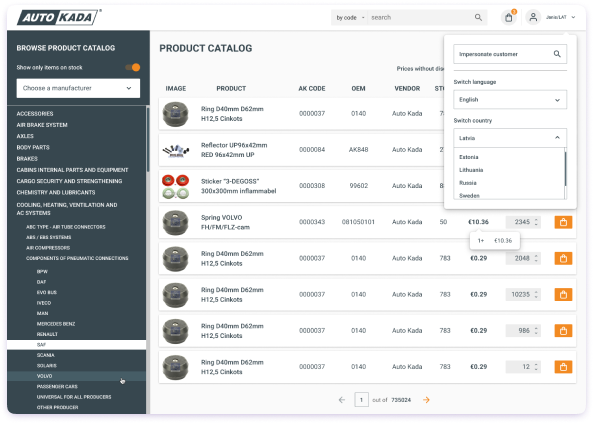
Operator tools - customer impersonation for support, plus country and language switching across the five markets the platform serves.
Why Custom, Not Off-the-Shelf
This is the kind of project where the build-versus-buy question resolves clearly to build. The off-the-shelf options exist - generic B2B platforms, marketplace-style storefronts, e-commerce frameworks with B2B modules - and any of them would have required years of structural workaround to fit the specifics: 735,000 SKUs with sub-second search, real-time multi-warehouse stock semantics, per-customer pricing across five markets, OEM cross-reference search, operator impersonation, and the mobile-first reality of how professional buyers actually use the platform.
Building it custom meant the data model was designed around the wholesale auto parts business, not around what a generic e-commerce vendor assumed. The result is a platform that does what the business does, not a platform the business has to work around.
What the Build Delivered
A B2B e-commerce platform that handles the catalog scale, the inventory complexity, the pricing logic, and the operator workflows that make wholesale auto parts actually work. Mechanics get the answer they need fast. Operators support customers against the same data the customers see. The business runs on a system that fits how it actually operates, not how a generic vendor thought it should.
Frequently asked questions
What was the scope of the Auto Kada project?
Why a custom build instead of an off-the-shelf B2B platform?
How does the real-time inventory work?
What does customer impersonation mean?
Which markets does the platform serve?
Published · Updated · Last reviewed
Reviewed by Ģirts Lediņš, CEO