What Our Financial Reporting Automation Services Include
We build complete automated financial reporting environments. Every engagement is scoped to your accounting landscape - these are the core capabilities we deliver.
Accounting System Integration
API-based pipelines connecting Xero, QuickBooks, Moneo, Jumis/Pro, Horizon, Ozols, and ERP systems with chart of accounts, journals, invoices, bank transactions, multi-entity, and multi-currency support.
- Xero, QuickBooks, Moneo, Jumis/Pro, Horizon, Ozols, ERP
- API-based data pipelines
- Chart of accounts & journal sync
- Invoice & bank transaction ingestion
- Multi-entity & multi-currency support
Automated Financial Statements
P&L, balance sheets, cash flow (direct & indirect), revenue breakdown, expense by department, and margin analysis - all auto-refreshed from live accounting data.
- Profit & Loss statements
- Balance sheets
- Cash flow (direct & indirect)
- Revenue breakdown
- Expense by department
- Margin analysis
Advanced Financial Analytics
Budget vs actual comparison, forecasting, cash flow forecasting, multi-entity consolidation, currency normalization, supplier/customer views, ageing reports, and drill-down to transaction level.
- Budget vs actual comparison
- Cash flow forecasting
- Multi-entity consolidation
- Currency normalization
- Supplier & customer views
- Ageing reports & transaction drill-down
Data Modeling & Governance
Semantic models, multi-entity consolidation logic, historical tracking, row-level security, workspace governance, and data dictionaries for financial reporting reliability.
- Semantic models
- Multi-entity consolidation logic
- Historical tracking
- Row-level security (RLS)
- Workspace governance
- Data dictionaries
AI-Enhanced Financial Insight
Natural language queries, anomaly detection, automated summaries, and Claude-assisted exploration built directly into your financial reporting environment.
- Natural language financial queries
- Anomaly detection
- Automated summaries
- Claude-assisted exploration
How We Deliver
Every financial reporting automation project follows a structured methodology designed to minimize risk, maximize accuracy, and deliver decision-ready financial intelligence from day one.
Financial Structure Assessment
Review chart of accounts, financial statements, and reporting expectations.
Integration & Data Mapping
Connect accounting platforms and map ledger structures into a unified model.
Data Modeling & Consolidation
Design scalable financial models supporting entities, currencies, and historical periods.
Dashboard & Statement Development
Build CFO-ready dashboards and drill-down reporting layers.
Automation & Governance Setup
Configure refresh schedules, permissions, and documentation standards.
Continuous Optimization
Refine KPIs, add forecasting models, and extend automation as business grows.
What makes us different
Most consultancies build dashboards. We build governed, automated financial intelligence systems designed to eliminate manual reporting and scale with your organization.
Finance-First Architecture
Every implementation is designed around financial data structures, accounting standards, and reporting requirements - not generic dashboard templates.
Deep Accounting System Integration
Direct API connectivity with Xero, QuickBooks, Moneo, Jumis, Horizon, ERP, and more - not CSV exports or manual imports.
Transaction-Level Transparency
Every financial statement supports drill-down to individual transactions, providing complete audit trail visibility.
Automation-Driven Efficiency
Automated refresh pipelines, scheduled data ingestion, and zero-touch month-end reporting that eliminates manual work.
Microsoft & Power BI Expertise
Official Microsoft partner with deep Power BI implementation experience across financial reporting, governance, and licensing.
Scalable Financial Intelligence
Multi-entity consolidation, multi-currency normalization, and forecasting models designed to grow with your organization.
Data Case Studies
Case studies coming soon.
Automate Your Financial Reporting Infrastructure
Book a strategy call and receive a comprehensive assessment of your current financial reporting architecture - before any commitment.
- Current financial reporting process evaluation
- Automation potential assessment
- Integration complexity analysis
- Governance readiness review
- Forecasting & consolidation needs assessment
Related reading
Why your Power BI reports are slow, and what actually fixes it
Slow Power BI is almost never a visual problem. It is the model underneath - too many columns, the wrong table shape, calculations running at view time instead of load time. Removing visuals treats the symptom. Fixing the model is what makes the report open in two seconds instead of forty.
Read article →
Why AI gets your numbers wrong, and how a modeled warehouse fixes it
AI gets your numbers wrong when it has to guess what a number means. Point it at raw tables and it invents a definition of revenue on the spot. Point it at a modeled warehouse, where revenue is defined once, and it reads the same figure your dashboard shows. The fix is modeling, not a better model.
Read article →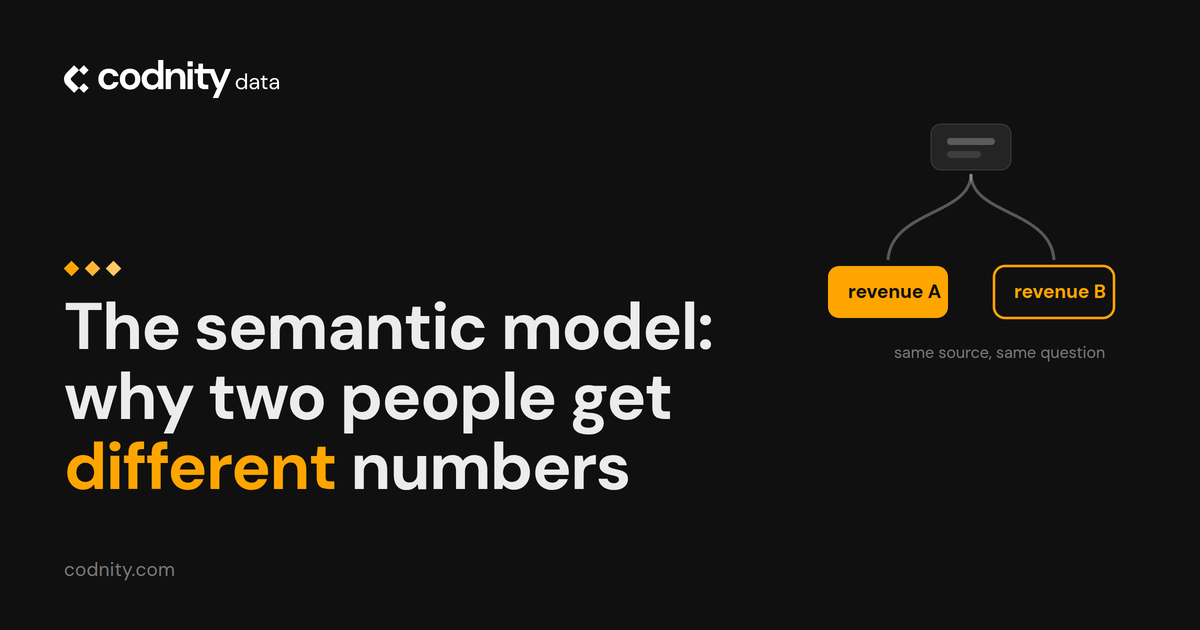
The semantic model: why two people get different numbers
When two reports disagree, the cause is almost never a bug. It is that the same metric was defined twice, slightly differently, by two people who both did reasonable work. A semantic model is where each measure gets defined once, so every report inherits the definition instead of recreating it.
Read article →Financial Reporting Automation FAQ
Everything you need to know before starting a financial reporting automation engagement with Codnity Data.