How your data gets from your tools to a report
Connectors read from your tools on a schedule. dbt cleans and structures the data through three layers, and Power BI and the AI assistant read the finished tables. We build and maintain every step.
 Managed data warehouse · PostgreSQLCentralized & secure
 clean · standardizestructure · join · test
 Power BIDashboards and reports, all reading the same tables.
 AI Assistant (Claude)Ask a question in plain language, get a chart or a written answer.
What a data warehouse is, and what “as a service” means
A data warehouse is a single database that collects data from all your business tools, cleans it, and stores it in a structure built for reporting and analysis rather than for running an app. “As a service” means you do not build or run it yourself: we set it up, connect your sources, model the data, and maintain it for a monthly fee, and you read the results in Power BI or by asking the AI assistant.
It is the clean, modeled layer that Power BI and the AI assistant read from. The difference from a plain database is that the data is already joined, tested and business-ready, and we build and run the whole thing for you.
What our data warehouse + AI service includes
Every setup is scoped to the tools you already use. These are the parts we build, connect and run for you.
A managed PostgreSQL warehouse
A dedicated database for your business, hosted in the EU. It is yours alone, not a shared tool, and you can export everything in it at any time.
- Dedicated PostgreSQL instance
- EU-hosted and GDPR-compliant
- Role-based access and an audit trail
- You own the data and can export it
- We start under NDA, read-only
Automated pipelines and dbt models
Connectors pull data from your tools on a schedule. dbt then cleans it, joins it and tests it through Raw, Staging and business-ready layers, the same way large data teams work.
- Connectors for CRM, accounting, project tools, web analytics, spreadsheets
- Refreshed every day (more often on higher tiers)
- dbt: Raw to Staging to Marts
- Automated tests catch bad data before a report does
- Full history kept for trend analysis
Power BI dashboards
Power BI connects straight to the finished tables, so reports open quickly and every report is built on the same figures. No Microsoft Fabric licence required.
- Native PostgreSQL connection (Import or DirectQuery)
- Dashboards that all read one set of tables
- Drill down from a total to the underlying rows
- Works with the Power BI you already use
AI analytics, powered by Claude
Type a question the way you would ask a colleague. The assistant answers from your warehouse, not from the model’s general knowledge, and shows the chart behind the answer.
- Ask in plain language, no SQL
- Get a chart, a table or a written summary
- Answers drawn from your governed data
- No waiting on an analyst to run it
Setup, monitoring and support
We design the data model, connect your sources and keep the whole thing running: nightly refreshes, monitoring, and changes as your tools and questions change.
- Done-for-you setup, usually live in a few weeks
- Refreshes monitored daily
- New sources and model changes handled for you
- A foundation ready for tools you add later
Data warehouse vs database vs data lake vs data mart
These four terms get used interchangeably, but they do different jobs. Here is the short version. Most companies reporting across a few tools need a warehouse.
| Data warehouse | Database | Data lake | Data mart | |
|---|---|---|---|---|
| Purpose | Reporting and analysis (OLAP) | Running an app day to day (OLTP) | Storing raw data to explore later | One team's slice of the warehouse |
| Data | Cleaned, structured, with history | Live, current records | Raw, any format | A cleaned subset |
| Who uses it | The whole business, for reporting | The application and its users | Data scientists and engineers | A single department |
| Best when | You report across several tools | You need fast reads and writes | You keep raw data for ML | One team needs its own view |
A spreadsheet is none of these. It has no automated pipelines, no shared source and no query engine, which is why it stops working once several tools and people are involved.
One monthly price, no per-query bill
Consumption-priced platforms charge more in a busy month, which is exactly the month you want people running reports. This does not. The warehouse, the pipelines and the maintenance are all in the base.
€250/month+€15per user
Book a demo →- The warehouse itself: PostgreSQL, EU-hosted, backed up
- Every connector to your source systems
- dbt models, tests and documentation
- Daily refreshes, monitored
- Power BI and the Claude MCP connection
- Ongoing maintenance when a source API changes
- Power BI licences, quoted separately at cost
- One-off migration of historic data, scoped up front

Related reading
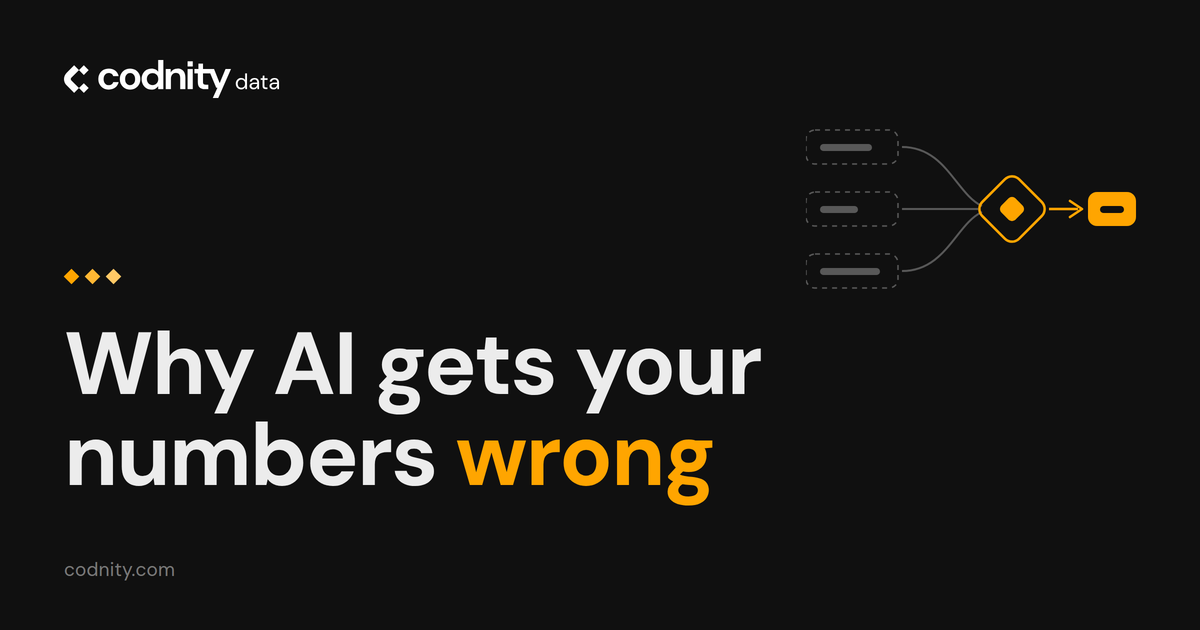
Why AI gets your numbers wrong, and how a modeled warehouse fixes it
AI gets your numbers wrong when it has to guess what a number means. Point it at raw tables and it invents a definition of revenue on the spot. Point it at a modeled warehouse, where revenue is defined once, and it reads the same figure your dashboard shows. The fix is modeling, not a better model.
Read article →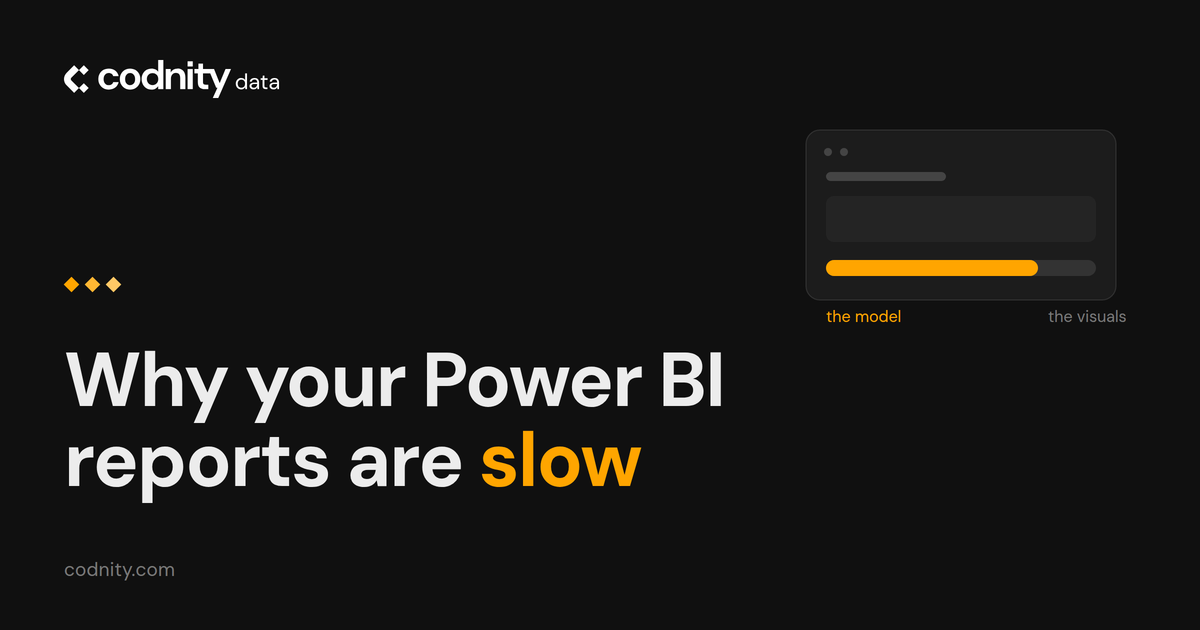
Why your Power BI reports are slow, and what actually fixes it
Slow Power BI is almost never a visual problem. It is the model underneath - too many columns, the wrong table shape, calculations running at view time instead of load time. Removing visuals treats the symptom. Fixing the model is what makes the report open in two seconds instead of forty.
Read article →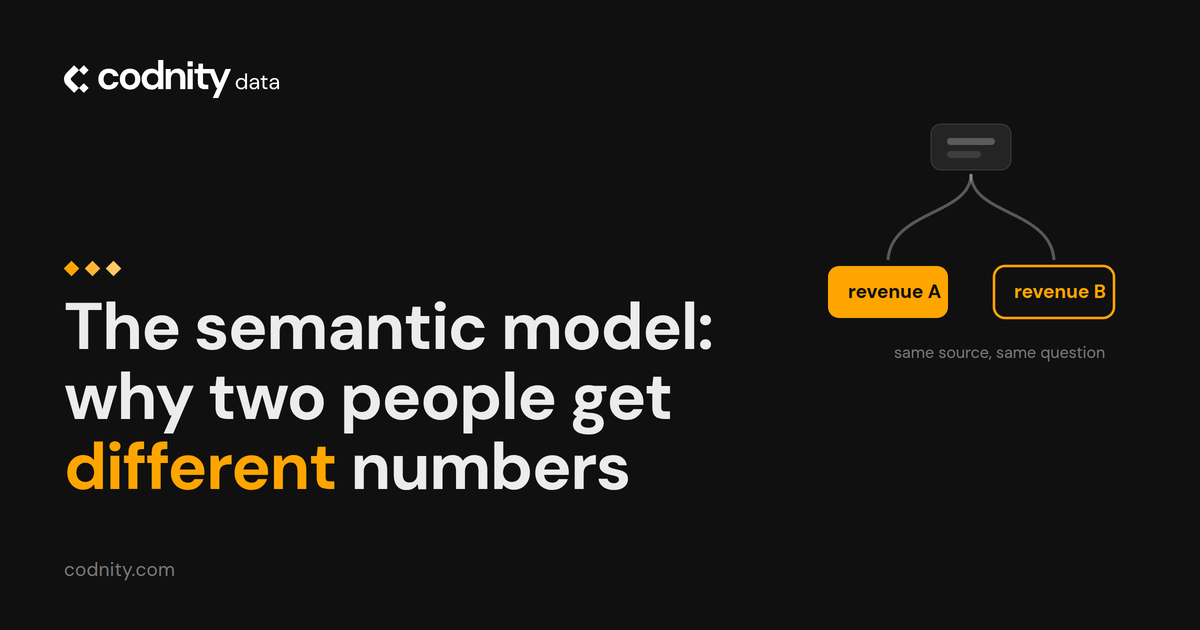
The semantic model: why two people get different numbers
When two reports disagree, the cause is almost never a bug. It is that the same metric was defined twice, slightly differently, by two people who both did reasonable work. A semantic model is where each measure gets defined once, so every report inherits the definition instead of recreating it.
Read article →See it running on your own data
Send us the tools your numbers live in. We will show you what one warehouse would pull together, what you could ask the AI, and what the setup would involve, before you commit to anything.
- A look at your current tools and data
- What a single source of truth would cover
- A walkthrough of Power BI and the AI assistant
- A clear, flat-price scope
Questions about data warehousing, dbt, PostgreSQL and the AI
Straight answers on what it is, how it works, and how the service is run.
What is data warehousing?
What is data warehouse as a service (DWaaS)?
How does the AI assistant work?
What is dbt and how is my data cleaned?
What database and tooling do you use?
How often does my data refresh?
How long does setup take?
Is Excel a data warehouse?
What is the difference between a data warehouse and a data lake?
Can Power BI connect to the warehouse?
Do I need a data team to run it?
How much does it cost?
Is my data secure and GDPR-compliant?
