Most businesses make the software decision backwards. They evaluate tools by price and feature list, pick the one with the best demo, and then spend the next three years building workarounds for what it can't quite do. The software doesn't change. The business bends.
The question of custom software versus off-the-shelf sounds like a technical decision. It isn't. It's a strategic one. The answer determines whether your operations are designed to fit someone else's product roadmap, or whether your technology is built around how your business actually works. Both are valid choices. The problem is that most organisations arrive at this decision by default rather than by design, and the default is almost always the off-the-shelf option.
The comparison almost always gets framed around upfront cost versus monthly subscription. That is the wrong frame. The real measure is total cost of fit: every process you've adapted, every workaround you've built, every integration you've paid for, and every competitive advantage you couldn't build because the platform wouldn't allow it. Modelled honestly over three to five years, that calculation resolves most of the uncertainty.
This article doesn't argue that custom is always right. It argues for being deliberate, because the default choice is almost always off-the-shelf, and the default is often made for the wrong reasons.
What Off-the-Shelf Software Does Well
Off-the-shelf software, particularly well-designed SaaS products, offers things custom development genuinely cannot match at the point of adoption. Speed is the most important. A capable SaaS product can be operational within days. Configuration, training, and onboarding are measured in weeks, not quarters. For a business that needs capability now - whether a startup validating a model, a company entering a new market, or a team trialling a new process - deployment speed is a real and legitimate advantage.
The second advantage is accumulated product development. A mature platform like Salesforce, SAP, or HubSpot carries years of iteration, customer feedback, and edge-case handling that no custom build could replicate at launch. The feature breadth is wide, integrations come pre-built, and the support infrastructure is established. For use cases that genuinely align with a platform's design intent, these are meaningful advantages that justify the licensing cost.
The honest summary: off-the-shelf software is the right choice when your requirements are standard, your scale is modest, and the fit is genuine. The errors occur not in choosing a platform, but in choosing one whose design intent doesn't match the problem, and then adapting the business to compensate rather than reconsidering the decision.
The Real Cost of Off-the-Shelf Software That Doesn't Fit Your Business
The monthly subscription is the most visible number in the off-the-shelf equation. It is rarely the most significant one. The actual cost profile of a generic platform includes per-seat licensing that scales with headcount, add-on modules required to reach the functionality your team actually needs, implementation and configuration fees that accompany every enterprise deployment, and integration development to connect the platform to the rest of your stack. None of these appear on the pricing page.
The scale of this problem is well-documented. McKinsey's research into large-scale IT implementations - the ERP rollouts, enterprise CRM deployments, and digital transformation programmes that define corporate software spending - found that the average project runs 45 percent over budget and delivers 56 percent less value than predicted at the outset. These are not custom builds. They are licensed platforms being configured, customised, and forced to fit organisations for which they were never specifically designed. The value gap is the cost of that fit.
Source: McKinsey & Company, "Delivering large-scale IT projects on time, on budget, and on value" (McKinsey Digital).
Underutilisation compounds the financial picture further. Analysis by Zylo, which tracks enterprise SaaS consumption across hundreds of organisations, found that companies waste an average of 44 percent of their SaaS investment on licences that are unused or underused. The subscription that looked affordable at sign-up becomes a significant line item once the full cost of adoption, workarounds, and parallel tooling is accounted for.
Source: Zylo SaaS Management Index (annual report).
The least discussed cost is the one that arrives last: migration. When the constraints eventually become unacceptable, replacing a platform your business has organised itself around - including data migration, process redesign, and retraining - is disruptive and expensive. A custom system built on sound architecture is far more tractable to evolve than a business that has shaped its workflows around a vendor's data model.
When Does Custom Software Development Make Sense?
Custom software development becomes the right choice when the total cost of adapting your business to a generic platform - measured across time, productivity, and strategic limitation - exceeds the cost of building the right system. That crossover arrives earlier than most organisations expect. Three signals reliably precede it.
The first is operational complexity a platform cannot represent cleanly. If your sales process has stages or data structures requiring structural workaround to fit a standard CRM, you are not getting the value the platform promises. You are paying for a framework and rebuilding it in the margins. The same logic holds for any core system: an ERP requiring parallel spreadsheets, an HR platform that can't model your compensation structure, a logistics system that doesn't reflect your actual dispatch logic.
The second is integration depth. Off-the-shelf platforms offer pre-built integrations for common pairings. When you need deep, bidirectional, event-driven connections between operational systems - ones that carry business logic rather than just moving data - you frequently end up building something custom regardless of where you started.
The third is competitive differentiation - and this is the one that gets underestimated most consistently. Consider what it actually means when your core system is the same product your competitors are also running. Not just a similar category of tool. The same platform, the same data model, the same workflow logic, the same feature roadmap controlled by a third-party vendor. Everyone on the same CRM has the same pipeline stages. Every team on the same project management platform operates within the same task structure. The same dispatch software produces the same dispatch logic. The software does not just reflect how you work - it shapes how you work. And when your competitors bought the same shaping force for the same monthly fee, the operational patterns it produces stop being a differentiator. You have all agreed, without realising it, to compete on the same terms.
Custom software inverts this entirely. Your system encodes your logic: how you qualify a lead, how you prioritise a job, how you price an engagement, how you manage a client relationship. That logic compounds over time as the system learns your operation rather than approximating it. It becomes a structural advantage - invisible to competitors, but felt in every decision the system supports. The businesses that understand this early stop asking what the software can do and start asking what the software lets them do that nobody else can.
A Custom Tool for the Waste Management Industry: What Happens When the Software Gets Out of the Way
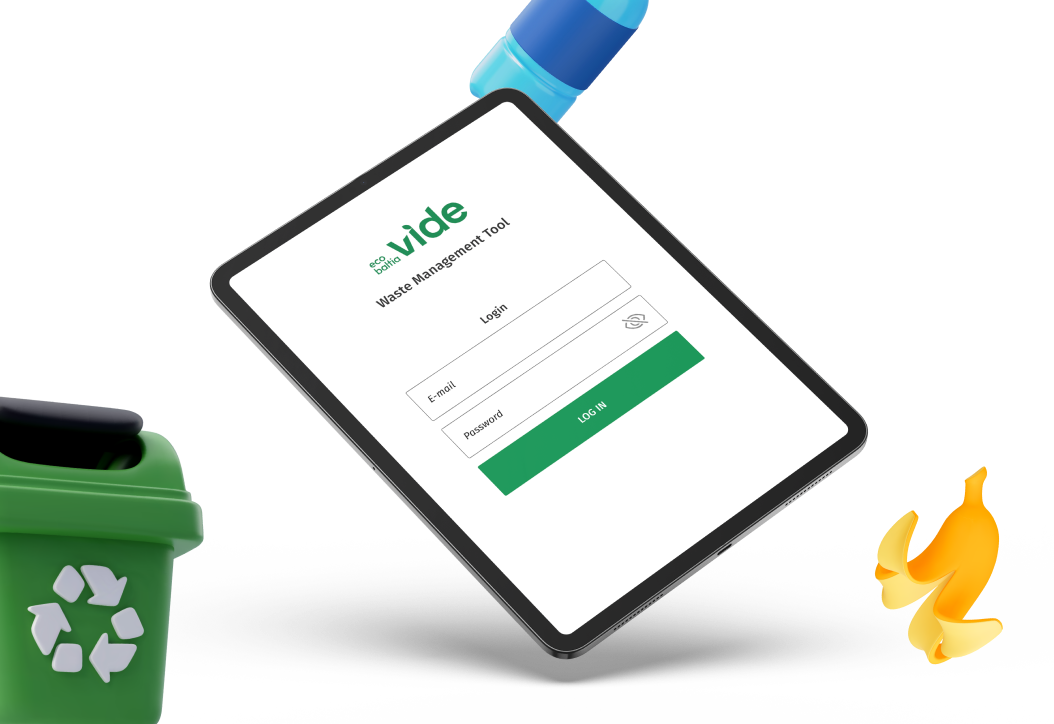
After working with multiple waste management companies, the same problems kept surfacing. Drivers were running routes on printed schedules and paper logs. The apps they had crashed mid-shift, or simply stopped syncing the moment a vehicle left network coverage. End-of-shift reporting routinely absorbed 20 to 30 minutes of time that should have been off the clock. The off-the-shelf options existed. None of them were built for how field crews actually work.
Rather than adapting a generic tool for each client, we built the product we would have recommended from the start. A Progressive Web App designed with drivers, not for them. It works fully offline, not partially. It is modular, so operators take only what they need. It connects directly to existing CRM systems and Google Maps without a separate integration project. One design constraint sat above all others: the app had to behave identically whether the driver was in the city centre or in a dead zone on the edge of a rural route.
The goal was not impressive software. It was software that stopped being a problem. Before the switch, drivers were losing time on every single shift: apps that froze mid-route, manual re-entries when sync failed, end-of-day logging that stretched well past the last collection, and a constant low-level anxiety about whether the tool would hold up. A few lost minutes per driver per shift does not sound significant until you multiply it across a full team and a working week. Those minutes become hours. Hours spent wrestling with software instead of doing the actual job.
When the tool finally worked the way the job works, that time went back to the work. More routes completed within the same hours. Less time on paperwork the system should handle automatically. And something harder to measure but just as real: drivers who were no longer anxious about the software. The app stopped being a burden they managed and became something they simply used. When software disappears into the workflow, it does not just reduce frustration. It gives people back hours they were spending on a tool that should never have needed their attention in the first place.
This is Codnity Dev's first independently launched product.
How to Make the Build vs. Buy Software Decision
The most useful frame for the build-versus-buy decision is not upfront cost: it is the relationship between the software's design intent and your operational reality. When a platform was built for businesses structured like yours, with requirements that map cleanly to its feature set, buy. The development has been done, the iteration has happened, the platform is fit for purpose.
When your requirements diverge from that design intent in ways that require structural workaround (not configuration, but workaround), build. The divergence will cost more over time than development would have upfront. The calculation resolves when modelled honestly: monthly subscription multiplied by years of operation, plus the productivity cost of the gaps, plus eventual migration cost, versus one-time build cost plus ongoing maintenance.
To be direct about the other side: if your requirements are genuinely standard, your team is small, and you are not yet at the scale where per-seat licensing becomes significant, off-the-shelf is almost certainly the right call. The framework works both ways. Custom development is right for specific circumstances, not as a default reaction to SaaS frustration.
The nuanced version reserves custom development for systems closest to your core value creation, and accepts generic platforms for commodity functions where differentiation doesn't matter. Your accounting system probably doesn't need to be custom. Your core operational system - the one that reflects how you do the thing that makes you money - probably does.
What Custom Software Development Actually Looks Like
Custom software development carries a reputation for being expensive, slow, and uncertain. That reputation comes from a specific type of engagement: large projects with poorly defined requirements and development relationships that built the wrong thing for too long before the misalignment became visible. That version is genuinely expensive. It is not what well-structured custom development looks like.
A well-built custom system starts with architecture, not code. Before any development begins, the requirements are mapped, the data model is designed, integration points are identified, and the build is phased to deliver usable functionality early. The first phase is typically operational in weeks, not months. Subsequent phases extend capability based on validated usage, meaning the final system reflects what the business actually needs rather than what it assumed it needed at the outset.
The outcome is software that fits your business precisely and evolves with it. The codebase is yours, the roadmap is yours, and so is the ceiling.
Why Custom Software Solves the Integration Problem That SaaS Can't
One of the most consistently underestimated costs in the build-versus-buy analysis is integration. Generic platforms offer pre-built connectors, and for standard pairings they work adequately. The complexity arrives at the edges: non-standard tools, proprietary data formats, real-time requirements, and business logic that needs to be applied at the point of data transfer rather than downstream. When those edge cases accumulate, the integration layer becomes as complex as any custom build, paid for on top of the vendor licences already in place.
The scale of this problem is significant. MuleSoft's annual Connectivity Benchmark Report has consistently found that integration work accounts for approximately 30 percent of total IT development time, a proportion that climbs when teams are building and maintaining custom integration layers on top of platforms that were never designed to connect the way the business needs them to.
Source: MuleSoft Connectivity Benchmark Report (annual).
Custom software built with an API-first architecture addresses this at the design level. Integration points are part of the architecture rather than an afterthought, built to your data model rather than around a vendor's. When you add a new system to your stack, the connection is an extension of existing architecture rather than a fresh negotiation with a new API.
Frequently asked questions
What is the difference between custom software and off-the-shelf software?
When does custom software development make more sense than off-the-shelf solutions?
Is custom software more expensive than off-the-shelf?
What are the main disadvantages of custom software development?
What are the disadvantages of off-the-shelf software?
How long does it take to build custom software?
Most custom software projects deliver working functionality in phases. A foundational first phase covering core workflows and primary integrations typically takes eight to sixteen weeks. More complex enterprise platforms are built across multiple phases,
How do I decide between custom software development and SaaS?
Published · Updated · Last reviewed
Reviewed by Girts Ledins, CEO